We’ve got o-rings!
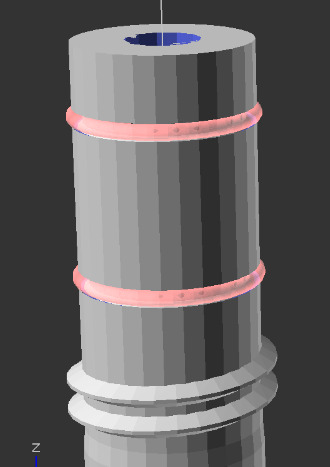
My gigantic box of o-rings arrived on Friday! I’ve just finished all the arithmetic to replace the wound thread on the chanter seat (the part that goes into the chanter cap) with a 15×1.5mm o-ring, on some little sample parts. Unlike some of my previous joint experiments, this is working fabulously! I’ve got an airtight joint that’s easy to take apart and put back together.
Compared to the more traditional wound joints, o-rings are simpler to build and replace, provide tighter and more uniform tolerances, don’t require lubrication, and provide a seal that’s just as airtight, if not moreso. The tubes need no modification, and will continue to work with David Daye’s components, and thread-wrapping. People who love thread can still wind the new joints if they want, they’ll just have to fill the o-ring channels with a bit more thread.
The downside to o-rings is that they’re slightly more difficult to source than thread.
The joints I still have to convert are:
- Chanter cap to chanter stock
- Blowpipe to blowpipe stock
- Bellows outlet to bellows
- Bellows inlet to bellows
For the blowpipe and bellows joints, I may want to dial up the squeeze percentage, to get a tighter fit that doesn’t pull apart as easily. I may also need to design a single o-ring on the bellows joints, since there’s not much depth to work with.
Measurements
I designed the joint to squeeze the o-ring by 15%, less than the 20-30% I saw on some manufacturer web sites, but they’re designing for 100+ pounds per square inch (PSI) of differential pressure, and a bagpipe is only going to have 20PSI at absolute maximum: probably more like 5PSI.
I designed the channel to be 1.35× as wide as the o-ring cross-sectional diameter, and 0.71× as deep. The gap between piston (chanter) and cylinder (chanter cap) is 0.1mm plus the 3D printer slop adjustment.
The o-ring needs to stretch, so the diameter of the channel must be greater than the inside diameter of the o-ring, but manufacturer web sites suggest it should not exceed 5% greater. I’ve added some assertions to the program to make sure the ring does stretch, but doesn’t over-stretch.
Finally, the o-rings I’m using for the chanter are 15×1.5mm. This provides a snug fit into the 17.8mm inside diameter of David Daye’s chanter cap.